All of StarNapp's sales documents —QUOTE, WORK ORDER, DELIVERY NOTE, PROFORMA and INVOICE— are part of the same family: they share a structure (header, chapters, lines, taxes) and move from one to the next through conversion, instead of being completely separate forms. This article is the general map; each step has its own article with the full detail.
In most cases we'll start from a QUOTE, but that's not mandatory: any of the five types can also be created independently, with no previous document, from the + button in Sales.
The quote can be converted directly into an INVOICE, DELIVERY NOTE or PROFORMA, or into a WORK ORDER if work needs to be carried out on the vessel first.
When we convert the WORK ORDER into a DELIVERY NOTE, PROFORMA or INVOICE, we choose whether we want to invoice from the QUOTE or from the work order itself. We can also convert the work order directly, skipping that choice, if it doesn't come from a quote.
A DELIVERY NOTE or a PROFORMA, in turn, can be converted into an INVOICE when it's time to invoice.
QUOTE → WORK ORDER → DELIVERY NOTE / PROFORMA / INVOICE.
QUOTE → DELIVERY NOTE / PROFORMA / INVOICE (direct conversion, without going through a work order).
QUOTE or WORK ORDER → DEPOSIT INVOICE, at any point where an advance payment has been agreed.
DELIVERY NOTE / PROFORMA → INVOICE.
INVOICE issued → CORRECTIVE INVOICE (cancels the original) or CREDIT INVOICE (offsets it, without cancelling it).
We can also COPY any document: unlike converting, this generates a new, independent document with no previous/next document relationship to the original.
If we agree an advance payment with the customer, we use the DEPOSIT on the quote or the work order (a percentage or an exact amount) and convert it into a DEPOSIT INVOICE. We can issue several successive deposits until the total is covered, and when we invoice the final document, these deposits are automatically deducted with the ADD button.
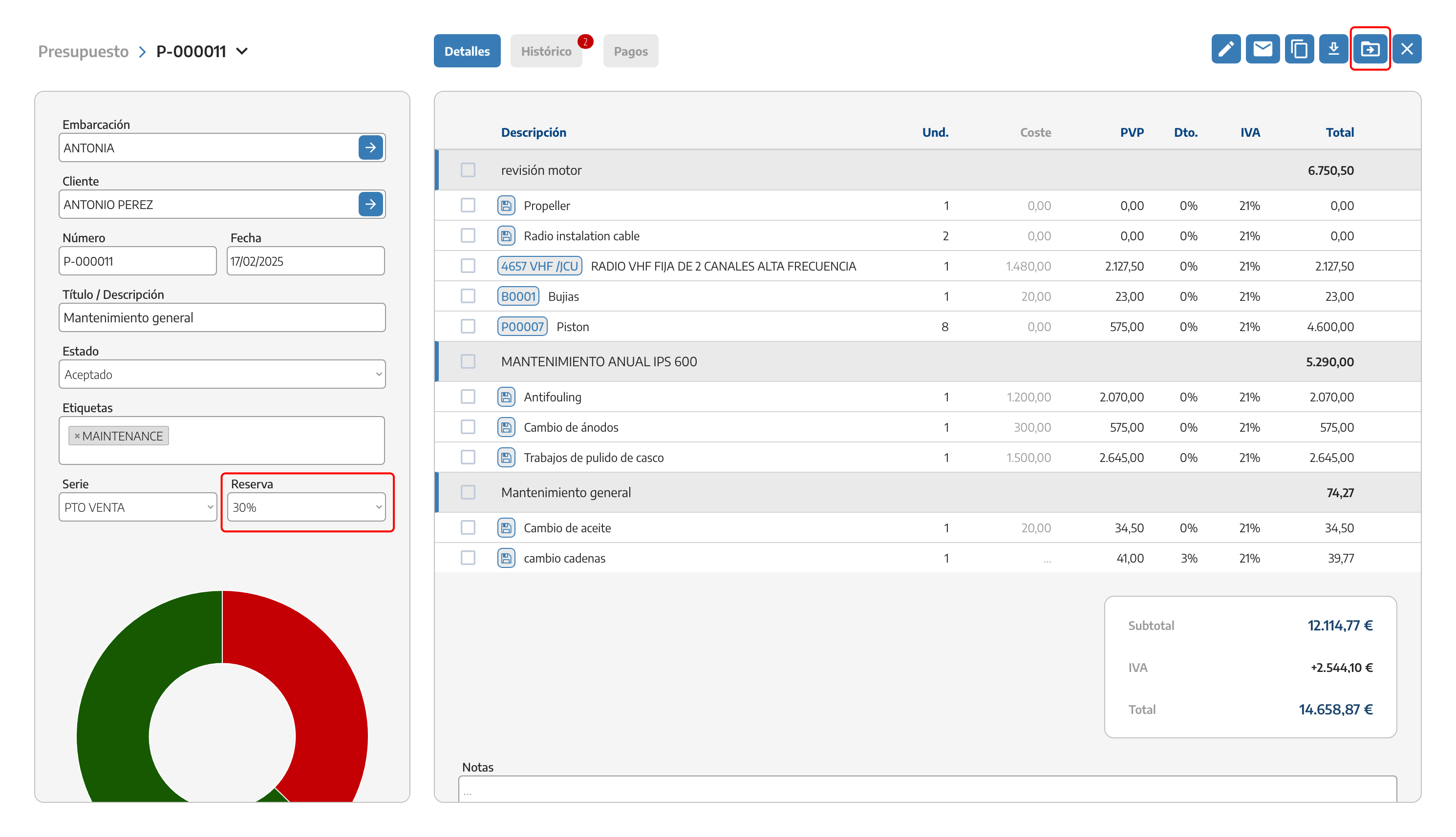
The full detail of this mechanism (DEPOSIT, successive deposits, and how they're incorporated with ADD) is in [Invoices](200-invoices.md).
An invoice already issued can't be edited or deleted. Any correction is made by generating a CREDIT invoice or a CORRECTIVE invoice from the CONVERT button on the invoice itself, never by editing it directly.
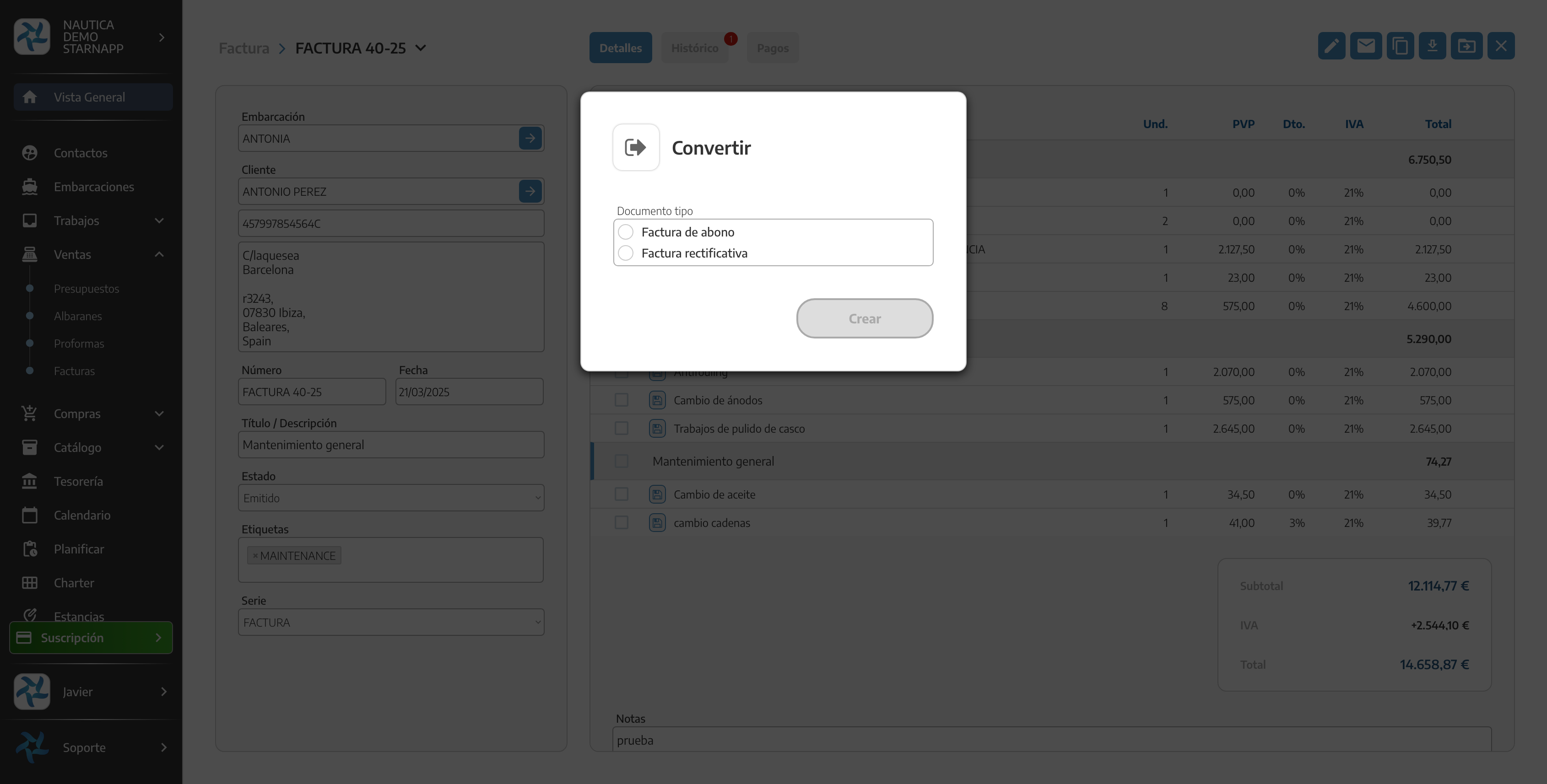
See the full detail in [Credit and corrective invoices](177-credit-and-corrective-invoices.md).
[Quotes](198-quotes.md) — create and manage quotes, optional chapters, DEPOSIT, linking to an existing work order.
[Work orders in sales](199-work-orders-in-sales.md) — the role of the work order in the sales flow.
[Delivery notes and proformas](140-delivery-notes-and-proformas.md) — when to use each one and how to turn them into an invoice.
[Invoices](200-invoices.md) — issuing regular, simplified and deposit invoices, and what to do after issuing them.
[Credit and corrective invoices](177-credit-and-corrective-invoices.md) — how to correct an invoice already issued.
[Converting documents](201-converting-documents.md) — the CONVERT button, the ADD mechanism and direct sales.
[Working with sales documents](202-working-with-sales-documents.md) — lines, chapters, images, supplied expenses, copying, translating and other actions common to all documents.
We don't always have to go through a quote or a work order: this map shows the possible paths, not a mandatory sequence.
The choice "invoice from the quote or from the work order itself" when converting the work order is made at the moment of converting; it isn't a fixed property of the document.